
A few weeks ago, I agreed to help a family organize an estate sale.
The homeowners had lived in their house for nearly 60 years. SIXTY. They'd raised their family there, celebrated countless holidays, experienced life's greatest joys and hardest moments, and accumulated six decades of belongings along the way.
How hard could an estate sale be?
Well.
On my first day, I showed up with two trash bags.
Two.
I look back at that now and laugh because I genuinely had NO idea what I was getting myself into.
Sixty years is a really, really long time.
One of the first things that struck me about the house was how little it had changed.
There were still pink tile countertops. A blue bathtub. Original 1960s cabinetry with those round brass pulls. The roof and windows had been replaced over the years, but so much of the house was exactly as it had been decades earlier.
It was like walking into a time capsule.
But what struck me even more was how much the house had become for its owners to manage.
The belongings had accumulated. Maintenance had become more difficult. And it was clear that the demands of caring for a longtime home had eventually exceeded what the homeowners could comfortably handle.
I found myself wondering why they hadn't moved sooner.
And then I remembered how emotional I was moving out of my first house after only seven years.
These people had lived in theirs for almost 60.
Sixty years of holidays. Birthdays. Family dinners. Ordinary Tuesdays. Amazing memories. The place that becomes a sanctuary when you're dealing with life's hardest moments. Memories that don't mean anything to a stranger but mean everything to the people who made them.
Of course leaving was hard.
It's one thing to recognize that a house has become too much to maintain. It's another thing entirely to say goodbye to most of your adult life.
When a lifetime of belongings has to be sorted in weeks
Here's something else I learned: sometimes families don't have the luxury of planning these transitions months in advance.
In this case, the decision to move happened quickly. So quickly, in fact, that even the homeowners' adult son was surprised.
They had clearly been thinking about moving for some time, but hadn't really talked about it with their family.
Within about a week and a half of the initial conversation, I was looking for an off-market buyer. A few days later, we were under contract. Three weeks after that, we closed.
And suddenly, nearly 60 years of belongings needed to go somewhere.
We'd contacted several professional estate-sale companies, but many were already booked months in advance. Some couldn't accommodate a sale until December.
We needed the house emptied in October.
There simply wasn't enough time.
We could have taken the easiest route and left the remaining belongings behind to be disposed of. That was an option.
But there were two reasons we couldn't bring ourselves to do that.
First, the family needed to recover as much financial value as possible. Even if the belongings didn't bring in a fortune, every dollar mattered.
And second, I kept thinking about what it would feel like to watch an entire lifetime of possessions end up in a dumpster.
The Christmas decorations. The furniture. The kitchenware. The photo albums we'd discovered tucked away in boxes.
Some of those things might not have been worth much money. But they had been part of somebody's life.
Even after hours of sorting and selling, I found that thought heartbreaking.
An estate sale couldn't preserve every memory. But at least it gave some of those belongings a chance to become part of someone else's story.
I underestimated the stuff. And the decisions.
By day two, I was legitimately mad at myself.
Not at the family. At myself.
Every cabinet revealed another collection. Every closet had more boxes. Every storage bin required another decision.
Keep it? Sell it? Donate it? Throw it away? Is it valuable? Is it sentimental? Does somebody in the family want it? Where should it go? What should we charge?
Now multiply those questions by thousands of objects.
I learned that decision fatigue is very, very real.
And here's what surprised me most: I was a physically and mentally capable 44-year-old woman with no personal attachment to any of these belongings, and I was completely overwhelmed.
Imagine being 85 and making those same decisions about the things you've spent your entire life collecting.
Or being the adult child trying to make them for your parents.
Or trying to do all of it while also navigating a move, a medical situation, or the loss of someone you love.
Suddenly, I understood why so many families struggle with this process.
It's not just about cleaning out a house.
It's about making thousands of little decisions, many of them emotional, when you're already exhausted.
Sometimes the stuff tells a story we don't know.
Years ago, when my family was cleaning out my grandmother's house, we found an extraordinary number of slippers.
So. Many. Slippers.
Why does a person need SO MANY SLIPPERS?!?!?
Some had never even been worn. They were still in their original packaging.
I couldn't understand it. Why would one person need that many pairs of slippers?
My mom explained that Grandma had lived through the Great Depression, when even little comforts weren't always available. Having nice slippers, being warm and cozy, was a luxury to her.
I had never considered that.
And suddenly, all those slippers made sense.
I've thought about that story a lot since my grandmother moved out of her home (after 55 years) about 9 years ago and it informed so much for me going into this estate sale.
We look at someone's belongings through the lens of our own experiences. But we don't always understand what those belongings represent to the person who owns them.
Maybe it's comfort. Maybe it's security. Maybe it's a memory. Maybe it's the satisfaction of finally being able to afford something they couldn't have when they were younger.
And sometimes, yes, maybe it's just the little thrill of buying something new.
(No judgment. I have absolutely purchased things because shopping was fun.)
But what happens when all of those things begin to pile up?
What happens when the possessions that once brought someone happiness eventually become more than they can manage?
I don't think there's a simple answer. And I certainly don't think the answer is to judge them.
I do think it's worth having a conversation about it before the responsibility falls to someone else.
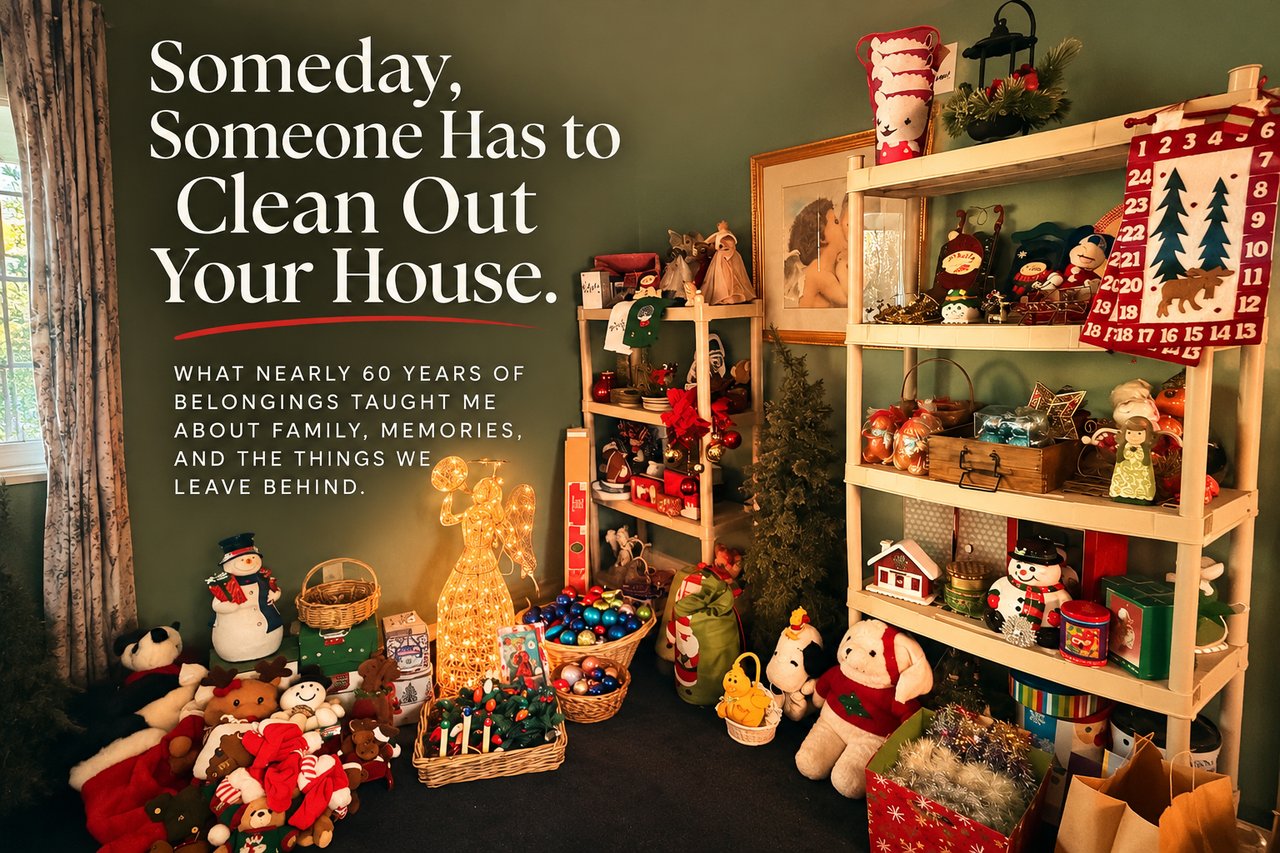
The Christmas decorations got me.
Of everything we sorted, I think the Christmas decorations were the most emotional for me.
If you know me, this probably isn't surprising.
I LOVE Christmas. I love decorating our home, creating traditions, collecting meaningful ornaments, and making the holidays magical for my family.
My grandmother (the same one with the slippers) gave us an ornament every Christmas. Usually Avon, of course. She'd label them with the year, and her intention was that when we grew up and had Christmas trees of our own, we'd already have a collection of ornaments with stories behind them.
I loved that tradition so much that Kevin (my husband) and I have continued it with our girls.
We also collect ornaments when we travel. We have ornaments from London, Venice, the British Virgin Islands, Mexico, France, Rhode Island, Vail during our wedding weekend, and so many other places.
They're little reminders of the experiences we've shared.
So when I found myself sorting through box after box of someone else's Christmas decorations, it made me sad.
I couldn't help wondering which ornaments had stories. Which ones had been hung by little hands. Which decorations had been part of the family's Christmas morning for decades.
And yet, there was so much of it.
So much that I wondered how anyone could remember the significance of every piece.
It made me think differently about my own collections.
Not because I want to get rid of the meaningful things.
Quite the opposite.
I want to make sure the meaningful things don't get lost among everything else.
Could we have done the estate sale ourselves? Yes. Would I do it again? Absolutely not.
One of the reasons I took on this project was that the homeowners are the parents of a very close friend. I wanted to help their family. I wanted to make an overwhelming transition a little easier.
And I'd already spoken with professional estate-sale companies.
One estimated approximately 75 hours just to organize, catalog, and price everything.
SEVENTY-FIVE HOURS.
At the time, that sounded outrageous.
In hindsight?
They were probably spot-on.
A proper estate sale requires an enormous amount of preparation. And when you don't do this for a living, you spend an incredible amount of time researching things that an experienced professional might recognize immediately.
We found everything from ordinary household goods to vintage collectibles and a fascinating old Hammond organ that sent me down a research rabbit hole I never expected.
Thank goodness for AI, because otherwise I might still be researching vintage kitchenware.
Even then, I suspect there were things we could have priced differently. There were items we knew had value but didn't necessarily know what a buyer would pay.
And then there's the actual sale. Marketing it, managing shoppers, negotiating prices, collecting payments, and coordinating removal.
It's a business. And I now have tremendous respect for the people who do it well.
Could a professional estate-sale company have generated more revenue? Possibly.
Would that have offset their fees? I genuinely don't know.
But here's something I do know: the value of hiring a professional isn't measured solely by how much money the sale brings in.
There's also the value of their expertise, their time, and the tremendous amount of physical and emotional work they take off a family's shoulders.
Unfortunately, there's another reality: professional help costs money, and not every family has the resources or time to make it happen.
Sometimes even when you know what the ideal solution would be, the circumstances don't allow for it.
And that's an important lesson, too.
There's a real estate lesson here, too.
I've been a Realtor for more than a decade, and I've walked through countless homes.
I know firsthand that buyers can look past dated finishes.
Pink tile countertops? Fine.
A blue bathtub? Sure.
Original kitchen cabinets? Someone might even love them.
But there's a difference between a house that's outdated and a house that hasn't been maintained.
Clean and cared for is not the same thing as updated.
And I think we sometimes forget how much that distinction matters.
A home doesn't necessarily need an expensive renovation before going on the market. But when buyers see extensive deferred maintenance and years of wear, the entire project can begin to feel overwhelming.
Instead of thinking, We can update this kitchen someday, they start wondering what else they're going to discover.
And that uncertainty can affect what they're willing to pay.
I know this neighborhood well, and I've seen longtime homes with very dated finishes attract strong buyer interest because they were clean, cared for, and ready for someone to imagine their next chapter.
Could additional work on this particular home have improved the sale price? I believe so.
Would the improvement have justified the time, expense, and labor required? That's a much harder question.
And it's why these situations deserve an honest, individualized conversation rather than a blanket recommendation to renovate, clean everything out, or sell as-is.
So what would I tell another family?
First, please don't wait until a move becomes necessary to start going through your belongings.
Do it a little at a time. Do it regularly. Open the boxes you haven't touched in 20 years. Revisit the closets. Deal with the things you've been meaning to deal with.
Second, have conversations about what's actually meaningful.
Ask your children whether they want the dining room furniture, the china, the collections, the Christmas decorations.
You might be surprised by their answers.
And try not to take it personally when they don't want something you love. They may not have the same memories attached to it.
Third, understand that preparing a longtime home for sale may involve far more than hiring a Realtor.
Estate-sale professionals, senior move managers, organizers, cleaners, haulers, appraisers—these services exist for a reason.
And if the budget allows, I would strongly encourage families to explore them early.
Because after this experience, I can confidently say that coordinating a full estate sale is not something I will be volunteering to do again.
Ever.
Do I regret helping? No. Would I do it again? Also no.
Both things can be true.
I went into this because I cared about the family and wanted to make a difficult transition easier. I learned an extraordinary amount about estate sales, aging, family dynamics, and the work that happens long before a home is ready for its next owner.
I hope, more than anything, that my involvement made a difference for them.
But I also learned that there's a very good reason professionals specialize in this work. It's physically demanding, mentally exhausting, and often deeply emotional.
Moving forward, I'll be a much better resource for families facing similar transitions because I've experienced it myself. I'll know what questions to ask, what challenges to anticipate, and why planning ahead matters so much.
I'll also be much quicker to recommend the people who do this for a living.
And I will happily leave the actual estate-sale organizing to them.
With tremendous respect.
From a very safe distance.
And now I'm looking at my own closets differently.
I already try to be selective about what I save from my girls' childhoods.
I don't keep every piece of artwork. I have bins for meaningful schoolwork and the things I think we'll enjoy looking back at someday.
I don't keep every outfit or every stuffed animal.
But I can also see exactly how this happens.
You put something in a bag because you don't have time to deal with it.
You stick the bag in a closet.
You tell yourself you'll get to it later.
And apparently, sometimes later is 60 years from now.
So I'll be more intentional.
The outgrown clothes can go. The toys nobody plays with can find new homes. And the collection of chargers for electronics that haven't existed in 20 years?
Kevin, I'm looking at you.
Will I become a minimalist?
Absolutely not.
Christmas alone makes that impossible.
But I want to be thoughtful about what we keep and why.
Because someday, someone will have to go through the things we've accumulated.
And when that day comes, I hope my babes find a home filled with memories worth keeping, rather than boxes of decisions we never got around to making.
I hope they find the Christmas ornaments with stories behind them.
I hope they find the photographs, the handwritten notes, and the little pieces of our lives that will make them smile.
And I hope they never have to wonder why their mother owned 47 pairs of unopened slippers.
Although if they do, I hope someone tells them the story.