

I fact-checked a viral real estate post—and the truth is a lot more interesting.
I saw a post on social media recently that stopped my scroll.
My first thought?
Ooooooh. That's interesting.
My second thought?
I need to fact-check that.
Because I love data. Like, really love data. Give me a neighborhood, a price point and access to historical sales and I will happily disappear down a rabbit hole figuring out exactly what's happening.
But there's something else I tell my clients all the time:
My crystal ball is in the shop.
Unfortunately, it has been there for quite some time.
I can tell you historically when the best time of year has been to sell a home. I can narrow that down from Denver to Castle Rock to Centennial and Littleton—and sometimes all the way down to a particular neighborhood and price point.
I can tell you what inventory is doing, how long homes are taking to sell, whether buyers are negotiating, how often sellers are reducing prices and how today's numbers compare with five or ten years ago.
What I cannot tell you is exactly what the housing market will do next year.
Neither can the guy on CNBC.
Neither can your uncle who sold all his stocks in 2008.
Neither can your parents who bought their first house in 1981 and lived to tell the tale.
Neither can the TikTok economist confidently announcing that housing is 90 days away from imploding.
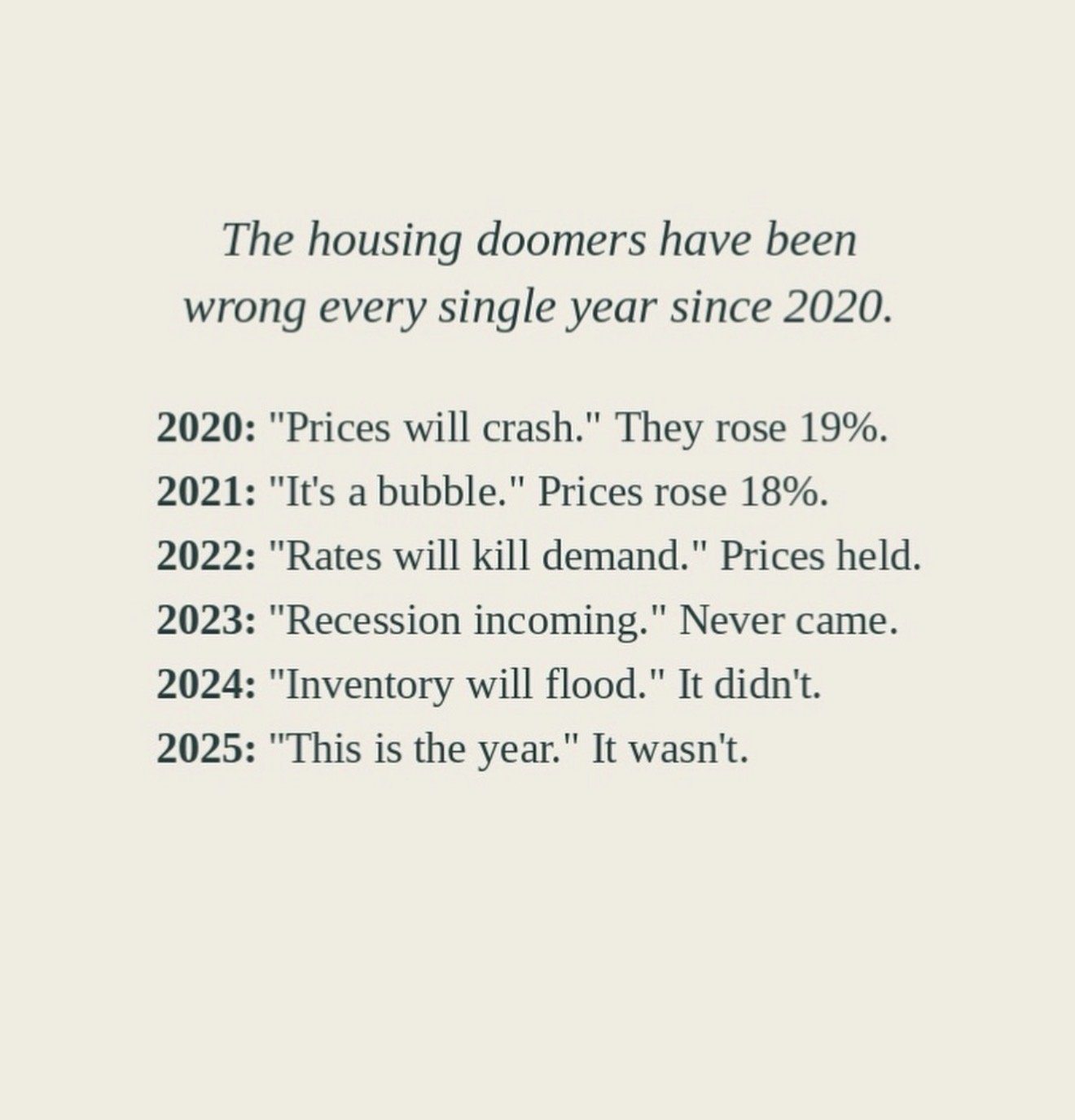
So when I saw a graphic claiming that the “housing doomers” have been wrong every single year since 2020, I wanted to know:
Were they?
Well… kind of.
The graphic gets the overall story more right than wrong, but several of its details need an asterisk.
In 2020, predictions of an imminent COVID-induced housing crash certainly didn't age well. Instead, extraordinarily low mortgage rates, limited inventory and intense buyer demand helped launch one of the fastest periods of home-price appreciation we've experienced.
Then came 2021, when housing really did go bonkers. Depending on the index you use, national home prices appreciated roughly 18–20%. Buyers competed against piles of offers, waived contingencies and routinely paid above asking. DO not recommend.
Plenty of people called it a bubble.
And plenty of people decided to wait for it to pop.
Then came 2022, and this is where the viral graphic oversimplifies things.
Interest rates did dramatically affect demand. Sales slowed as borrowing became much more expensive. Prices didn't collapse nationally in the way many predicted, but higher rates absolutely changed what buyers could afford—and therefore changed the market.
In 2023, the recession that seemingly everyone had predicted didn't materialize. U.S. real GDP actually grew 2.5% that year.
And in 2024, the graphic says inventory “didn't flood.”
I'd call that one misleading. Inventory did increase significantly. It just didn't produce the nationwide glut—and resulting price collapse—that some people expected.
By 2025, things became even more interesting. National home prices were still slightly higher year over year, but real estate was becoming increasingly regional. FHFA ultimately reported national appreciation of 1.8% from Q4 2024 to Q4 2025—but prices declined in nine states and Washington, D.C. (this included Colorado).
Which brings us to today.
2026: Welcome to the weird market
This is exactly why I don't like sweeping statements about “THE housing market.”
There isn't one.
What's happening nationally isn't necessarily what's happening in Colorado. What's happening in Colorado isn't necessarily what's happening in metro Denver. And what's happening in metro Denver may not tell me what I actually need to know about a $900,000 house in Castle Pines.
That's why I care so much about drilling down into the data.
Is it a buyer's market or a seller's market for your house, in your neighborhood, at your price point?
That's the question I care about.
And right now, many Denver-area buyers have something they haven't had much of in a very long time:
Leverage.
There is considerably less competition in many segments of our market. Buyers may have room to negotiate on price, inspections, repairs, concessions and other terms that would have been laughable requests during the frenzy of 2020 and 2021.
But there's an obvious reason for that, too.
Borrowing money is expensive right now.
As I write this on September 14, 2026, I'm seeing mortgage rates around 7.17%.
Please don't come back to this blog in three weeks and yell at me because that number is different.
Mortgage rates can—and do—change quickly, sometimes even within the same day. Your actual rate will also depend on your lender, loan program, credit profile, points and other factors.
But for purposes of this conversation, let's call it what it is:
Borrowing money to buy a house is expensive right now.
And that brings me to a phrase you've probably heard approximately 4,000 times over the past few years.
“Marry the house. Date the rate.”
I was on a coaching call recently with a mortgage professional who lends in 48 states, and she brought up this familiar saying.
Her argument was essentially this: yes, mortgage rates are substantially higher than they were during the pandemic years. But today's buyers also face considerably less competition in many markets.
That can create opportunities to negotiate on price, seller concessions, repairs and other terms. And if rates eventually fall, refinancing may become an option.
There is truth in that.
But I'd add a giant asterisk.
Do not buy a house today that you can only afford if rates fall tomorrow.
We don't know that they will.
Mortgage rates have fluctuated enormously throughout history. We've experienced the almost-unbelievable sub-3% rates of 2020 and 2021, and we've also experienced rates above 18% in the early 1980s.
So yes, rates move.
But “rates move” and “rates are definitely going down soon” are two very different statements.
Could today's buyer eventually refinance into a meaningfully better rate?
Absolutely.
Do I think we'll someday see a number lower than today's 7.17% again?
I certainly hope so.
Can I tell you when, how much lower, or whether it will happen soon enough to matter to a particular buyer?
Nope.
Please see aforementioned broken crystal ball.
So I'd actually rewrite the saying:
Marry the house. Date the rate—but make sure you can afford the marriage even if the rate never calls you back.
Not quite as catchy.
Considerably better financial advice.
And ask what “refinance later” actually means.
This is something I wish more buyers knew to ask about before choosing a lender.
Some lenders offer programs promising future refinances with “no cash out of pocket.” That can be a legitimate and valuable benefit.
But here's another important asterisk:
“No cash out of pocket” does not necessarily mean “free.”
Those costs have to go somewhere, and I pr=omise no financial institution is just going to give it away.
Depending on the program, a lender may cover certain costs through a lender credit tied to the rate, some fees may be waived, or costs may be rolled into the new loan balance.
If they're financed, you're still paying them. You just aren't writing a check for them at closing.
So if a lender tells you, “Don't worry—you can always refinance later,” here are some questions I'd want answered:
- What exactly does your future refinance program cover? Which lender fees are waived, and which third-party costs—title, appraisal, recording fees, etc.—could still apply?
- If I'm bringing $0 to closing, where are those costs going? Are they being added to my loan balance? Am I receiving a lender credit in exchange for a different rate?
- How far would rates need to fall before refinancing actually saves me money? Ask them to calculate the break-even point, not just show you a prettier monthly payment.
- Will I have to qualify again? What happens if my income, employment, credit, debt or home value changes?
- Are there restrictions on when or how often I can use the program?
- What happens to my loan term? If I've been paying my mortgage for several years and refinance into a new 30-year loan, a lower payment may partly come from stretching the debt over a longer period—not just from the lower rate.
Those aren't reasons not to buy.
They're reasons to understand exactly what you're buying.
And they're really good questions to ask your lender before you're emotionally attached to a house.
So… should you wait?
Here comes everyone's least-favorite Realtor answer:
It depends.
I don't think you should buy a house simply because someone tells you rates will fall.
I don't think you should sell a house because someone tells you prices are about to crash.
And I don't think you should put your life on hold because someone with a microphone confidently predicts where housing will be 12 months from now.
What I do think is that today's market can present some genuinely interesting opportunities for buyers who are financially ready.
Think about the tradeoff.
The 2021 buyer got an incredible interest rate—but may have had to fight 15 other people for the house, offer above asking, waive protections and accept terms almost entirely dictated by the seller.
Today's buyer may pay considerably more to borrow the money—but in the right situation, that buyer might have time to think, negotiate the purchase price, request an inspection, ask for repairs, negotiate concessions or walk away without 14 people waiting behind them.
Neither market is universally “better.”
They're different.
And that's where strategy matters.
My job isn't to predict the market. It's to navigate it.
There are things I can't control.
I can't control mortgage rates.
I can't manufacture buyers.
I can't make a house worth $100,000 more because that's what someone needs it to be worth.
And I certainly can't tell you what the Federal Reserve is going to do six months from now—or exactly how mortgage markets will respond when they do it.
What I can control is how well I prepare my clients.
I can dig into the data until we understand what's happening not just nationally, but in your neighborhood, your price range and your segment of the market.
I can help you identify where you have leverage.
And when we're negotiating, one of the things I do best is figure out just how much to give away.
That might sound counterintuitive coming from someone whose job is to negotiate for you.
But real estate negotiations aren't poker tournaments.
Sometimes strategically sharing why something matters to my client completely changes a negotiation.
There's an art to giving the agent on the other side enough information to understand where we're coming from—without giving away something that weakens my client's position.
I want the other agent to trust me. I want them to know I'm a professional.
And while we absolutely represent different clients with different interests, we're also two professionals trying to solve the same problem:
How do we get our clients across the finish line with the very best outcome possible?
That relationship has saved deals.
It has gotten my clients terms I don't think we'd have gotten otherwise.
And it becomes even more valuable in a market filled with uncertainty.
Because ultimately, I don't need a crystal ball to do my job well.
I need good data.
I need experience.
I need to understand the people sitting across the table.
And I need to know the difference between the things we can predict, the things we can prepare for and the things we simply cannot control.
So if you're wondering whether you should buy, sell, wait, refinance later or sit tight and see what happens, I'm not going to tell you I know what the market will do next.
But I will happily pull apart the data with you until we know exactly what your options look like today.
The crystal ball, unfortunately, remains in the shop. 😉